




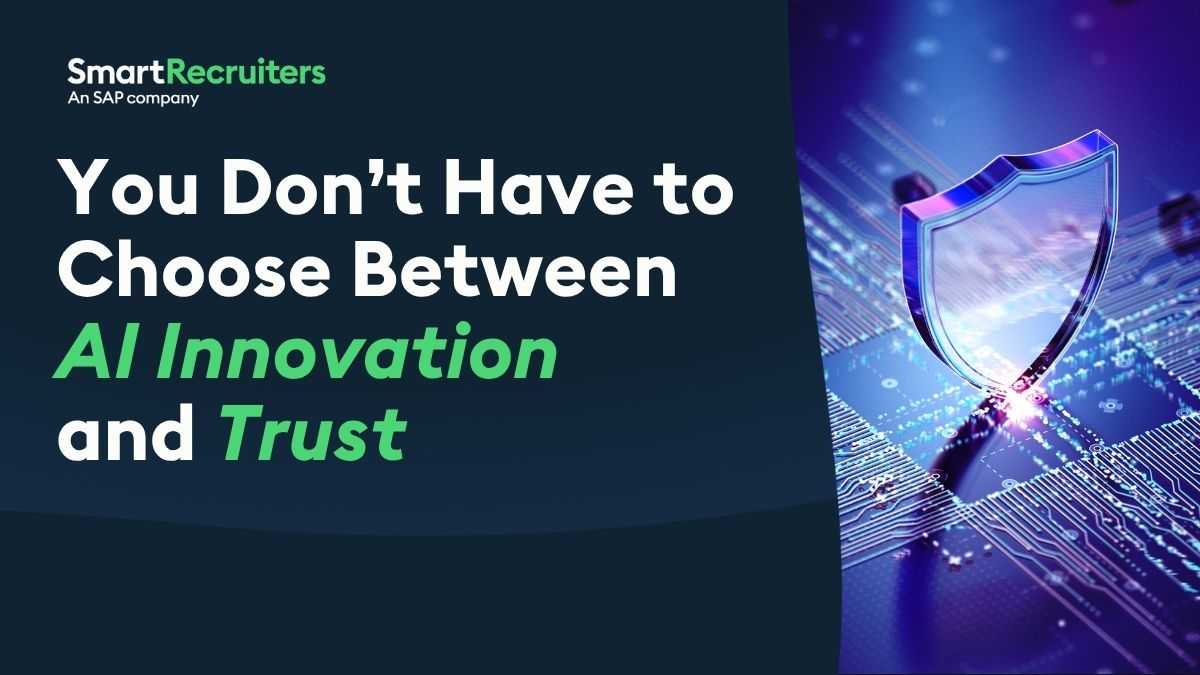
You Don’t Have to Choose Between AI Innovation and Trust
AI has rapidly moved from experimentation to expectation.
For CHROs and CTOs, the pressure is clear: adopt AI, move faster, and unlock new levels of efficiency across hiring and workforce management. But alongside that urgency is another equally critical mandate—maintain trust.
Trust in data.
Trust in decisions.
Trust in how AI impacts people.
Too often, these priorities are framed as a trade-off: move fast with AI, or move carefully to preserve trust.
That framing is wrong.
The organizations leading in AI today aren’t choosing between innovation and trust—they’re designing for both from the start.
The false trade-off holding organizations back
At the executive level, hesitation around AI is rarely about capability. It’s about risk.
Will the data be accurate?
Will decisions be explainable?
Will systems behave as expected at scale?
“Trust isn’t the constraint on AI innovation—it’s the prerequisite,” says Rebecca Carr, CEO of SmartRecruiters. “If your systems aren’t trusted, they won’t be used. And if they’re not used, they don’t deliver value.”
This is where many organizations get stuck. They pilot AI in controlled environments but struggle to scale it across the enterprise.
Not because the technology isn’t ready—but because the foundation isn’t.
Why trust breaks down in AI systems
AI doesn’t operate in isolation. It relies on the systems, data, and workflows that already exist inside the organization.
And in many enterprises, those systems are:
- Fragmented across multiple platforms
- Built on inconsistent or incomplete data
- Governed by unclear ownership and policies
When AI is layered onto that environment, issues surface quickly:
- Outputs are inconsistent or difficult to explain
- Data discrepancies undermine confidence
- Users revert to manual processes
“AI amplifies whatever environment it operates in,” Carr explains. “If your data is fragmented or your workflows are disconnected, AI will reflect that. Trust breaks down not because of AI—but because of what sits underneath it.”
This is why trust can’t be added later. It has to be built into the system itself.
Innovation that earns trust
For AI to scale in HR, it needs to move beyond isolated features and into embedded workflows—supporting decisions in real time, across the full hiring lifecycle.
But that level of integration requires more than technology. It requires intentional design.
Leading organizations are focusing on three core principles:
1. Unified data foundations
Trust starts with consistency.
That means establishing:
- A single source of truth for talent data
- Clear definitions for roles, skills, and performance
- Real-time synchronization across systems
Without this, even the most advanced AI will produce outputs that feel unreliable.
2. Transparent and explainable systems
Executives, recruiters, and candidates all need to understand how decisions are made.
This doesn’t mean exposing every technical detail—it means ensuring:
- Decisions can be traced back to data inputs
- Outcomes can be explained in business terms
- Users have visibility into how AI is influencing workflows
“Trust comes from clarity,” says Carr. “People don’t need to understand every algorithm—but they do need to understand the outcome and why it makes sense.”
3. Governance that enables scale
Governance is often seen as a barrier to speed. In reality, it’s what makes speed sustainable.
Strong governance includes:
- Defined ownership of systems and data
- Clear access controls and permissions
- Ongoing monitoring and auditing of AI performance
When done right, governance doesn’t slow innovation—it accelerates adoption by giving teams confidence to use AI in critical workflows.
From AI tools to AI systems
One of the biggest shifts happening in HR tech is the move from standalone AI tools to fully integrated systems.
This is where trust and innovation converge.
“In the past, AI sat on the sidelines—suggesting, scoring, assisting,” Carr says. “Now, it’s becoming part of the system itself, helping to coordinate and execute work. That only works if the system is designed to support it.”
When AI is embedded into connected workflows:
- Recruiters trust recommendations because they’re grounded in real data
- Hiring managers act faster with full context
- Candidates experience consistency across every touchpoint
The result isn’t just efficiency—it’s confidence at every level of the organization.
The role of leadership
For CHROs and CTOs, building trust in AI isn’t just a technical challenge—it’s a leadership one.
It requires alignment across:
- HR, IT, and business stakeholders
- Strategy and system design
- Speed and discipline
It also requires a shift in mindset—from viewing trust as a constraint to recognizing it as a competitive advantage.
Organizations that get this right don’t just deploy AI faster. They scale it more effectively, with higher adoption and stronger outcomes.
A new standard for AI success
The next phase of AI in HR won’t be defined by who has the most features.
It will be defined by who can:
- Integrate systems effectively
- Build trust into every layer of the architecture
- Deliver consistent, explainable outcomes at scale
“AI doesn’t replace human judgment—it enhances it,” Carr says. “But for that to happen, people need to trust the system they’re working in. That’s the real work of innovation.”
Final thought
AI innovation and trust are not opposing forces.
They are interdependent.
The more advanced your AI becomes, the more critical trust becomes. And the stronger your foundation of trust, the faster you can innovate.
For CHROs and CTOs, the path forward is clear: Don’t choose between innovation and trust.
Build systems where both are inherent.
You may also like
Key features of agentic AI in candidate relationship management
Agentic AI transforms candidate relationship management by unlocking dormant talent data, ... Read more
AI in Recruitment: The Future of Hiring for 2026
Discover the transformative role of AI in recruitment and how it reshapes hiring practices for ... Read more
Unlocking Performance: The Role of AI in HR Analytics and Decision-Making
Discover how AI in HR transforms decision-making and analytics to boost employee performance and ... Read more
Latest Resources
- Key features of agentic AI in candidate relationship management
- AI in Recruitment: The Future of Hiring for 2026
- Unlocking Performance: The Role of AI in HR Analytics and Decision-Making
- Your Agentic AI Glossary: 15 Enterprise AI Terms Every HR Leader Should Know
- Data is everything: enabling or improving your talent strategy through improved talent visibility