




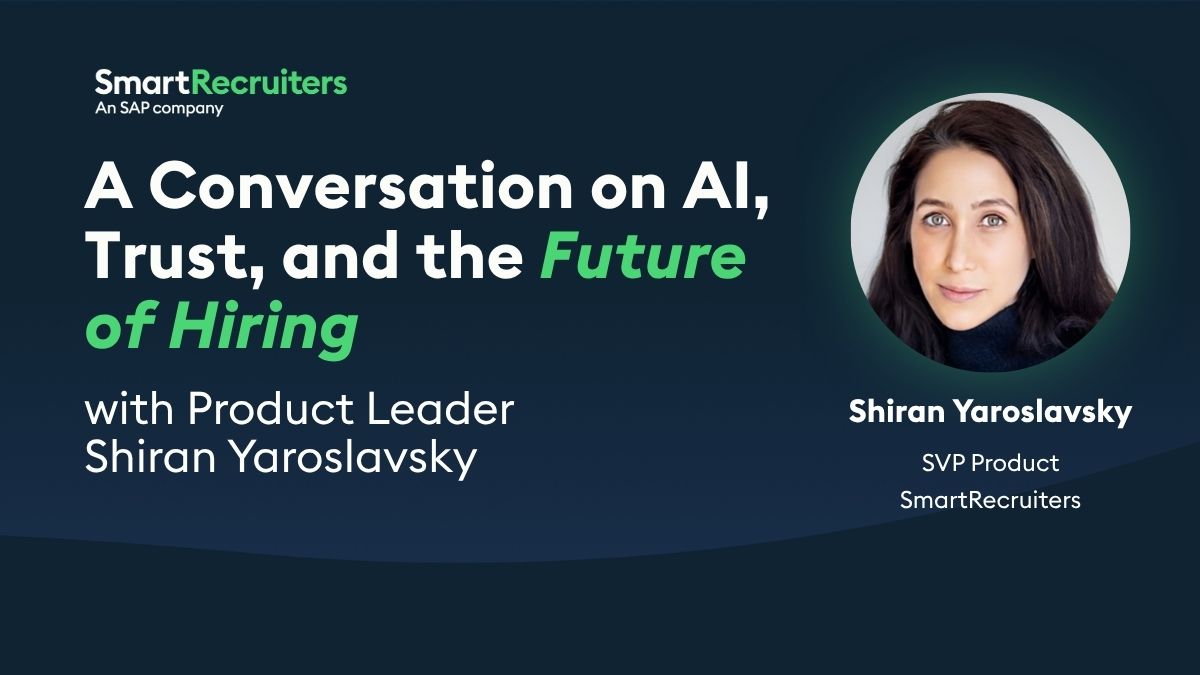
A Conversation on AI, Trust, and the Future of Hiring with Product Leader Shiran Yaroslavsky
When generative AI broke into the mainstream with ChatGPT in 2021, it did so with a bang; millions flocked to test its uncanny ability to produce text, code, and ideas on demand. That first wave was loud, visible, and impossible to ignore. The next one is quieter. But it may matter more.
Enter agentic AI. To paraphrase the Wall Street Journal, it’s the technology that everyone’s talking about, but no one understands. A fitting description for a technology designed to disappear into the background. When it works, it doesn’t announce itself. It simply gets things done.
To make sense of what’s changing and what it means for the future of talent acquisition, we sat down with Shiran Yaroslavsky, SVP of Product at SmartRecruiters. The goal: to look under the hood of agentic AI, and more importantly, to understand how it can start working for you.
First, a quick primer. Generative AI is reactive: you prompt, it responds. Agentic AI is proactive: you assign a goal, and it acts. Ask it to schedule an interview, and it won’t just suggest times; it will coordinate calendars, resolve conflicts, and follow through. It doesn’t just generate content; it executes tasks.
And those agents won’t just sit on one side of the hiring process. Candidates may soon deploy their own. Imagine a recruiting agent flagging a missing document, pinging a candidate’s agent, and receiving the file, no emails, no chasing, no friction. The exchange happens while both humans are offline, or simply focused elsewhere.
Quietly, the mechanics of work begin to shift.
Let’s get into it.
SmartRecruiters: This year, McKinsey’s Future of Work report proclaimed the future of workforces to be agentic. As a product leader in the hiring space, can you help us understand this prediction?
Shiran Yaroslavsky: One concrete example comes to mind; I have a friend who recently sold their business, and they told me they want to start a new project, but they can’t imagine managing a 500-person company again. My first reaction was, you don’t have to! There are so many companies realizing crazy revenue with just a few dozen people. All this to say, what you are able to accomplish now with the combination of human and AI skills is night and day from just a couple of years ago.
SR: What do leaders need to think about when it comes to agent-to-agent technology and workforce planning?
SY: Going into the future, teams will have to look at a task and decide if it’s something they want to build an agent for or whether it’s something better done by a human. It’s a new freedom, but also a new skillset that we all need to hone. At the same time, we see a familiar foundation for success, and that’s effective collaboration. You need to be able to collaborate, right? Collaboration between agent and worker, agent and leadership, and even agent and agent will be the key to impact.
We already see Microsoft and Google aligning on standards that make collaboration with agents and building agents more accessible. As the barriers lower, the question we need to keep in mind is: In a world of so many so many agents, how can we connect them to each other and not create silos?’
Again, the idea of collaboration is so top of mind for us. As we are building Winston, our SmartRecruiters hiring agent, we are thinking about how Winston will go out and interact with other agents. Maybe you are defining your sourcing strategy to Winston, and he is then communicating with agents from job boards, or when a recruiting question comes up internally, Winston is recognizing that and providing answers by collaborating with other agents an organization might have, like SAP’s Joule.
SR: How should agent-to-agent technology change the way CTOs and CIOs think about their tech stack?
SY: Agent-to-agent tech opens up a level of complexity and questions about security and governance we haven’t seen before. There’s the question of managing your agents, tracking what’s plugging into what, and who has access to what. So the admin experience should be a major focus for anyone overseeing their organization’s tech stack. Admins need to be in the driver’s seat with full visibility and full control of where, how, and to whom AI is deployed, which is something to keep in mind when evaluating their current system or any new technologies.
SR: Do you have any advice for organizations looking to optimize their AI usage and impact?
SY: This question all comes down to product. We know the threshold for building an AI assistant, copilot, or agent is getting lower, but that’s different than delivering a really great experience. It’s not just about running fast; there needs to be excellence when it comes to UI, UX, data flow. For example, how it plugs into your existing tech stack and hiring data to create a more holistic experience for your users. These items will be the make-or-break for the success of your AI programs.
If you’re interested in learning more about agentic AI in action, then check out the product preview webinar from SmartRecrutiers with Shiran Yaroslavsky alongside CEO, Rebecca Carr and SVP of Engineering at SmartRecruiters, Michał Nowak.
You may also like
Key features of agentic AI in candidate relationship management
Agentic AI transforms candidate relationship management by unlocking dormant talent data, ... Read more
AI in Recruitment: The Future of Hiring for 2026
Discover the transformative role of AI in recruitment and how it reshapes hiring practices for ... Read more
Unlocking Performance: The Role of AI in HR Analytics and Decision-Making
Discover how AI in HR transforms decision-making and analytics to boost employee performance and ... Read more
Latest Resources
- Key features of agentic AI in candidate relationship management
- AI in Recruitment: The Future of Hiring for 2026
- Unlocking Performance: The Role of AI in HR Analytics and Decision-Making
- Your Agentic AI Glossary: 15 Enterprise AI Terms Every HR Leader Should Know
- Data is everything: enabling or improving your talent strategy through improved talent visibility